
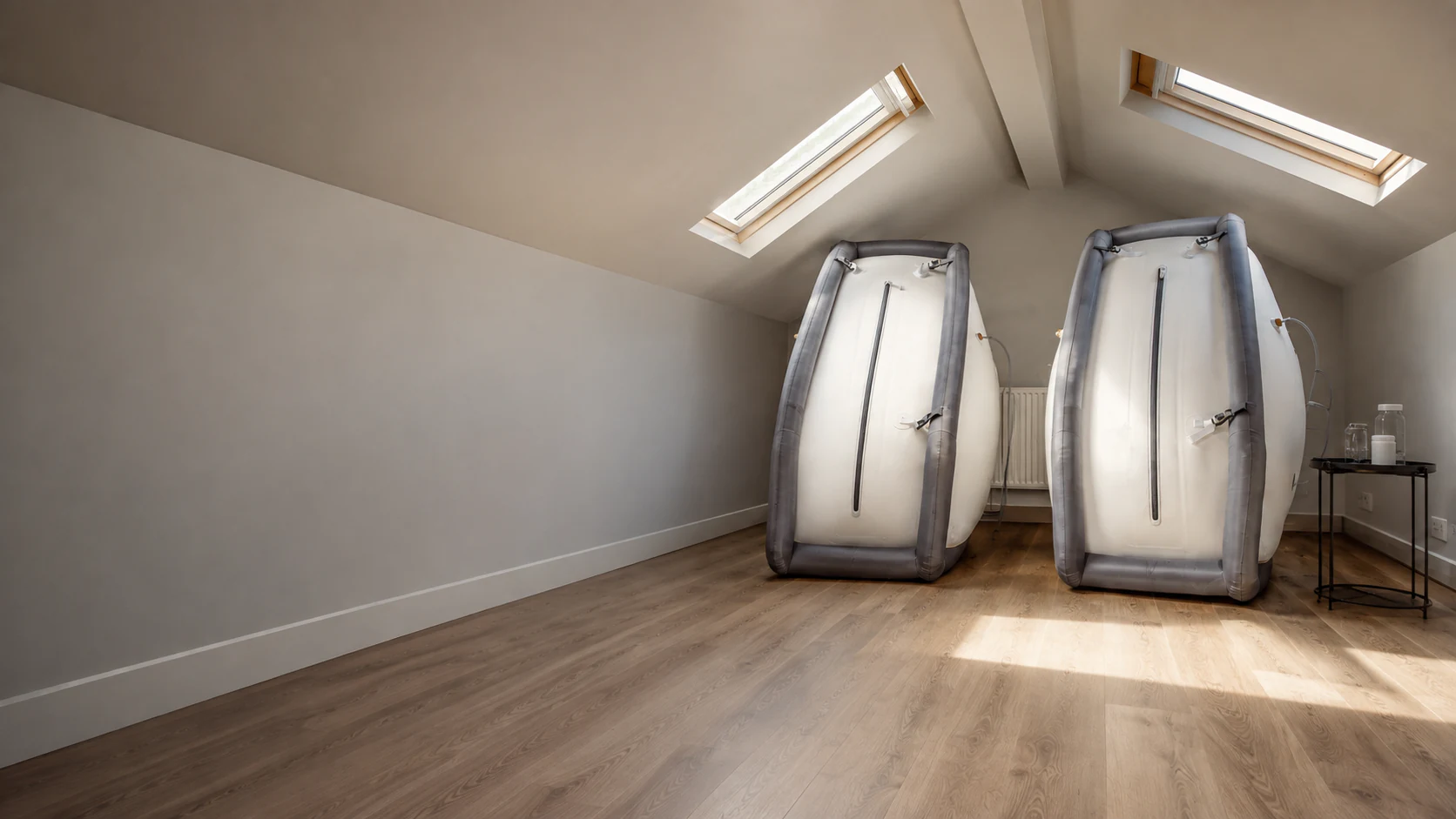
Pressure and oxygen concentration determine what a hyperbaric session delivers. We publish both, so you can compare our chamber with the research you are reading rather than relying on a category name.
- Pressure
- 1.5ATA
- Oxygen
- 93–98%
- At pressure
- 60min
- Occupancy
- 1
152 kPa.
Concentrator, 4–10 L/min.
Plus pressurisation and decompression time.
Not a shared multiplace.
What 1.5 ATA means.
Breathing room air at normal pressure, you carry roughly 0.3 mL of oxygen dissolved in every decilitre of plasma. At 1.5 ATA on 93–98% oxygen, that rises to roughly 3.0 — about ten times as much, carried independently of your red blood cells. That is the mechanism, and it is the same mechanism at any hyperbaric pressure.
How it compares with higher-pressure research.
Most published hyperbaric research runs at 2.0 to 2.4 ATA. Ours is 1.5. That is roughly 57% of the dissolved-oxygen load of a 2.4 ATA clinical dive, and it means we cannot present the outcomes of those trials as what happens here.
Where a study on one of our condition pages was run at a higher pressure, that page says so. Where it was run at 1.5 ATA — as the post-concussion trial was — that page says that too. This is the whole reason we publish the number at all: so you can check the research against the chamber instead of taking our word for the connection.
The useful part
You can check every claim against the chamber.
Each condition page names the pressure and session count used in the relevant research. When the match is close, we say so. When it is not, we say that too. That gives you a clearer basis for deciding whether a session—or a course—is worth trying.